Use Case

Verification partners

The end of payslip fraud

Key benefits

  • Instant decisioning, every time: Replace manual verification queues with source-verified data delivered in seconds. Your underwriting workflow can move directly from application to decision without waiting on document review, HR callbacks, or third-party data bureaus. Loan processing times drop from days to seconds, enabling true straight-through processing for income-dependent lending products.
  • Document fraud, eliminated by design: Verifiabl removes the need to detect document fraud entirely. Rather than analysing a payslip and trying to identify whether it has been altered, your system receives the original source income data directly from the payroll provider's environment. Whether a fraudster has manipulated the visible document, generated a fake one with AI, or attempted to forge details, none of it affects the data you receive. This is structural fraud prevention, not detection.
  • Built for direct integration into underwriting workflows: Verifiabl returns structured JSON payloads designed for direct ingestion into automated decisioning systems, with schemas customised to match your existing data model. The API uses standard REST endpoints with full documentation, sandbox environments, and dedicated engineering support. For lower-volume use cases or one-off verifications, a secure web dashboard is available with no engineering work required.
  • Lower verification costs and a better applicant experience: Manual income verification carries significant costs once analyst time, overhead, and rework are accounted for. Verifiabl operates on a pay-per-verification model that delivers the same outcome at a fraction of the cost, with no setup fees, no minimum commitments, and no document review required. Applicants experience faster outcomes with no need to chase HR or upload additional documentation.
Source-verified data, delivered in seconds. Fraud prevention through architectural design, not document analysis.

FAQ

How does Verifiabl verification work?
keyboard_arrow_down

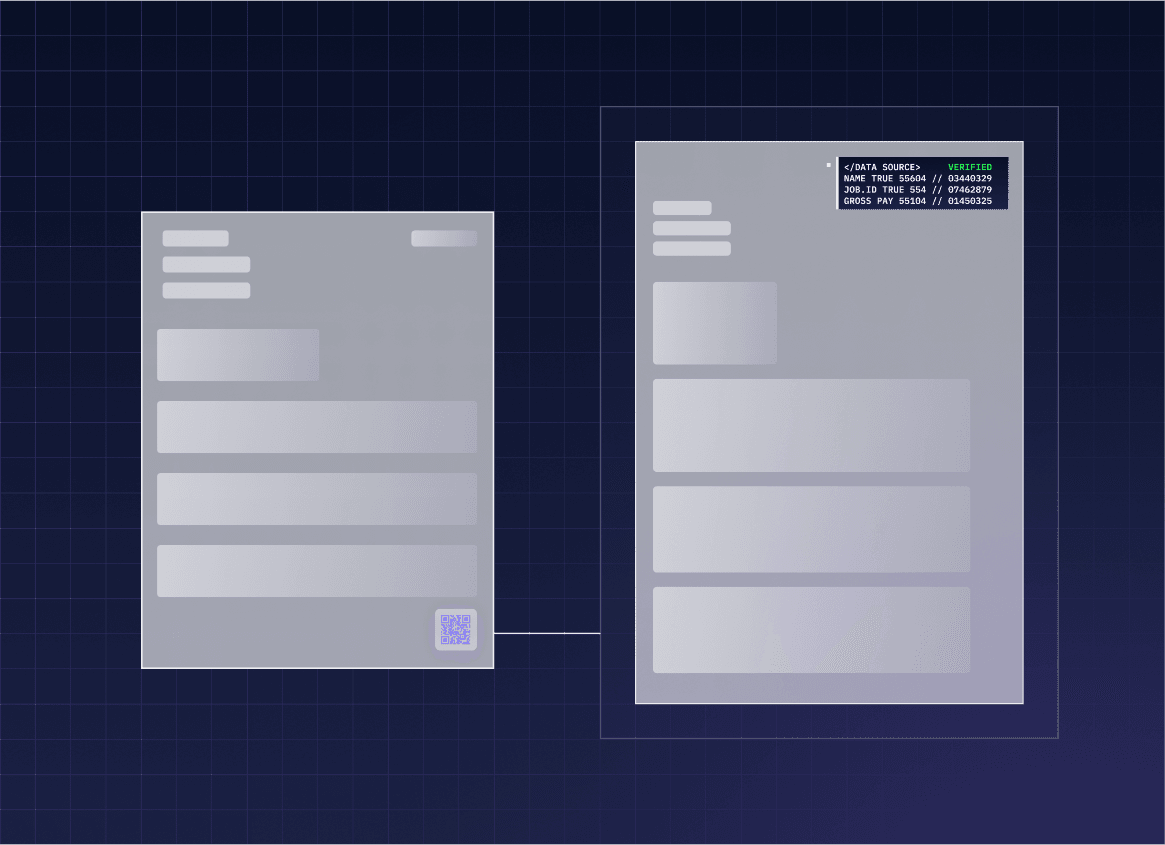
When an applicant submits a payslip containing a Verifiabl barcode, your system passes the barcode data to the Verifiabl API. Verifiabl decrypts the embedded payload and returns the original source income data - exactly as it was generated by the payroll system at the time of the payslip's creation - to your system in a structured format. The entire process completes in seconds, with no manual intervention. Your decisioning is based on the source data itself, which means the physical payslip simply becomes a secure delivery mechanism for cryptographically sealed information.

How does Verifiabl prevent fraud?
keyboard_arrow_down

Verifiabl eliminates document fraud entirely by making the document itself irrelevant to your decisioning. Rather than analysing a payslip and trying to detect whether it has been altered, your system receives the original source income data directly from Verifiabl - the same data the payroll system generated at the moment of payslip creation. Whether a fraudster has manipulated the visible document or attempted to forge details, none of it affects the data you receive. You can still compare the source data to the physical document if your workflow requires it, but the architectural intent is to bypass document analysis altogether.

How is the verified data delivered to our systems?
keyboard_arrow_down

Verifiabl returns structured data in JSON format, designed for direct ingestion into automated decisioning systems and underwriting engines. The schema can be customised to match your existing data model, so the integration requires minimal mapping work on your side. You receive only the data fields agreed in advance with your team - Verifiabl applies purpose limitation by default, so no information beyond what is needed for the verification is shared. The API is built for both real-time and batch use cases.

What does it take to integrate Verifiabl?
keyboard_arrow_down

Integration is lightweight by design. Verifiabl provides REST API endpoints with full documentation, a sandbox environment for testing, and dedicated engineering support throughout onboarding. For lower-volume use cases or one-off verifications, a secure web dashboard is also available, requiring no engineering work at all.

What's the commercial model?
keyboard_arrow_down

Verifiabl operates on a pay-per-verification model. Lenders and other accredited verifiers pay a fee for each verification performed, with no setup fees, subscription costs, or minimum commitments. Pricing is structured to reflect the volume and nature of each partner's use case - enterprise lenders, credit unions, and brokers all access the same platform on terms appropriate to their scale. Specific pricing is discussed during commercial onboarding.

How does Verifiabl ensure privacy and compliance?
keyboard_arrow_down

Verifiabl is built on a zero-PII-storage architecture: personally identifiable information remains encrypted within the payslip itself and is only decrypted at the moment of verification, after the employee has chosen to share the document. The infrastructure is AU-resident and designed to align with the Australian Privacy Principles. We are currently completing our ISO 27001 certification. Full audit trails are maintained for every verification event and made available to verification partners for compliance reporting and dispute resolution.

How do we get started?
keyboard_arrow_down

The simplest way to begin is to reach out to our partnerships team at contact@verifiabl.io. We typically begin with a discovery call to understand your verification volumes and decisioning workflow, followed by technical documentation, sandbox access, and a working proof of concept. From there, we work directly with your engineering and risk teams to deploy the integration into production. Most lenders move from initial conversation to live verification within a few weeks.

See it in action

Reach out to see how Verifiabl is preventing fraud and streamlining lending applications while protecting employee privacy.

Get in Touch